
The interstitium, a previously unknown human organ recently revealed through a new technically enhanced way of seeing, has implications for functioning of all organs and systems in the body.
Researchers believe the discovery may be the biggest organ in the body. The skin, which for an adult can weigh up to eight pounds and cover 22 square feet, has usually been considered the body’s largest organ. Researchers describe the interstitium as an extensive three-dimensional network of interconnected fluid-filled cavities that is found throughout the body under the skin and in tissues of the gut, lungs, digestive and urinary systems and blood vessels.
A New York Times story by Jacey Fortin explains research on this new-found feature of human anatomy began in 2014 when endoscopists and gasteroenterology experts at Mount Siniai Beth Israel Hospital in New York examined a patient’s bile duct.
A Networked Pathways of Moving Fluid
Using new imaging technology that let them see living tissue inside the body, these specialists saw the fluid –filled compartments supported by a meshwork of proteins. Doctors have been looking at this tissue for years, but the fluid filled areas and their three dimensional supports have not previously been visible. When tissue samples are removed from the body the structures collapse and the view under a microscope makes them look like dense tissue. Fortin writes that images captured with the new visual technology show a fluid that ebbs and flows, like the ocean, with similarly underexplored mysteries. This extensive networked system may function as a shock absorber for other parts of the body, may be implicated in many aspects of health, and may also be a means of transmission for diseases. It drains into the lymph system and could be a conduit for the spread of cancer.
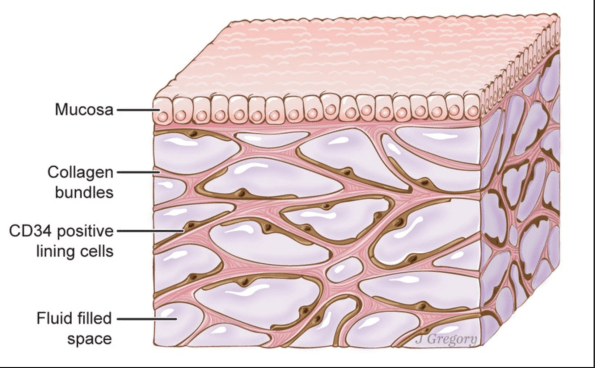
The interstitium, showing collagen bundles, mucosa, and interstitial fluid.
Image from Wikipedia
Neil D. Theise, MD, is a professor in the Department of Pathology at NYU Langone Health and co-senior author of a new paper describing the interstitium in Scientific Reports. “This finding has potential to drive dramatic advances in medicine, including the possibility that the direct sampling of interstitial fluid may become a powerful diagnostic tool,” he said in a NYU press release.


