Complex Challenges of Coronvirus

As business and government leaders struggle to protect public health and forestall economic devastation in the wake of the coronavirus pandemic that has already sickened 351,731 people and killed 15,374 world-wide, scientists are racing to understand how the novel coronavirus works.

The disease Covid-19 is caused by the virus SARS-Co-V-2. It’s one of several corona viruses that have caused diseases such as the common cold, flus, SARS, and MERS, in humans. These viruses can enter the body through the mouth nose and eyes, and health experts warn the members of the public to wash hands regularly and keep hands away from the face. Covid-19 seems to be more dangerous than flu or SARS. There is no medical treatment or vaccine.

Can’t smell or taste? You may be infected.

Early symptoms can mimic colds and flu. A New York Times story by Roni Caryn Rabin reports 30 percent of 2,000 South Korean patients who tested positive for the virus lost their sense of taste and smell. Doctors in several other countries have found a loss of both senses in Covid-19 patients, and consider those losses a likely infection marker. British ear, nose and throat doctors say people who suddenly lose ability to smell and taste, even if they have no other symptoms, should suspect they’ve been infected and self-isolate for seven days.

We’ve been told that the illness is spread by droplets in the air caused by coughing, sneezing and breath of infected persons and by contact with infected surfaces. A New England Journal of Medicine report on the life-span of the virus molecules outside a human host’s body says they can remain viable in air for up to three hours, on plastic and steel for up to 72 hours, on cardboard for 24 hours, and on copper for four hours. Under certain conditions these pathogens may live longer.

The New York Times has a graphic of How Coronavirus Hijacks Your Cells

How the contagion works
Screen Shot 2020-03-23 at 5.00.52 PM

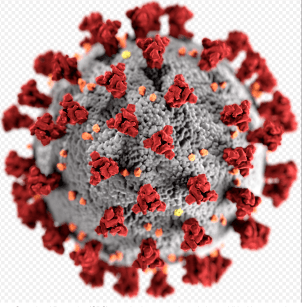
We’ve all seen of the illustrations that show a SARS-Co-V-2 particle as a ball tightly covered with ominous looking club-shaped red spikes. A Nature story by Smriti Mallapaty explains the    significance of those spikes, and the reasons Covid-19 seems to be more contagious than seasonal flus and the virus that caused SARS.

According to the Nature story, genomic analysis has shown that the SARS-Co-V-2 virus has a spike protein that it uses to infect target cells, a process in which its protein binds to the membrane of the target cell. The binding maybe activated by specific enzymes. Unlike its close relatives, the story says, the SARS-Co-V-2 virus appears to have a protein that is activated by the host cell enzyme furin. Because furin is found in many human tissues, including those of the lungs, liver and small intestines, the virus has potential to attack multiple organs. Chinese researchers found that other related coronaviruses don’t have furin activation sites.

A team of researchers at the University of Texas at Austin found that a Sars-Co-V-2 protein binds very tightly to receptor in human cells—called ACE 2 receptors. The identification of receptor sites, the story says, suggest the possibility of future vaccines or therapies that could block receptors and make it harder for the invading protein to enter the cell. Read the story here. Researchers say more study is needed on activation sites.

An ancient protector: Soap

Soap maybe the best defense against infection. Recipes for soap made from fat, wood ash and water have been found on Babylonian clay containers dating back to 2800 BCE. And this ancient invention and its descendants efficiently attacks today’s scourge. Palli Thordarson, a chemistry professor at the University of New South Wales, who posted a viral Twitter thread on the wonders of soap, explains how soap doesn’t just wash the viral molecules away. It demolishes them.

Thordarson explains soap is made of molecules called amphiphiles that have a dual nature. One end of the molecule is attracted to water and repelled by fats and proteins. The other side of the molecule is attracted to fats and is repelled by water. It’s this dual-nature chemical construction that makes soap so effective. “When you buy a conventional soap, it consists of a mixture of these amphiphiles,” Thordarson explains. “And they all do the same thing. ”

The SARS-Co-V-2 virus is an enveloped virus, which means basically that it lives inside a protective layer of fat. The fat-loving side of the soap molecules burrow into the virus’s fat layer and tear it up, while the soap’s water-loving side pulls it into the wash water, wrecking the whole structure. The viral structure has to be intact to infect a cell. Thordarson says regular soaps are fine. Agents that fight bacteria won’t fight viruses, and Thordarson doesn’t recommend antibacterial soaps anyway.

Watch soap smashing the viral particles: https://www.youtube.com/watch?v=s2EVlqql_f8&feature=emb_share&fbclid=IwAR0QVpN1JVfzLmyMCUEghxfu30jiySTMn9P7amT96k8DWKlLFaE7zyfWanc

Now What?

Right now, SARS-Co-V-2, and its cascading impact, leaves us with more question than answers.

How do complex systems—such as economies and the public health—respond when perturbed by massive events such as natural disasters and the spread of a deadly disease?

What happens to large systems in the aftermath of extreme perturbation? Will they ever be the same again? What conditions would let them bounce back to something like their previous state? Or should they?

South Korea used GPS tracking to find patients who violated quarantines, and offenders were fined. In China, officials went door to door and took temperatures, ordering those with fevers not to leave home. These extreme measures apparently halted the spread of infection. Will Western societies tolerate such intrusions?

What can we expect to learn from the pandemic of 2020?

Will climate change and human destruction of natural environments create conditions that favor more novel diseases and more pandemics?



Nature’s Most Deadly Events Happening More Often as Global Temperatures Rise

Screen Shot 2020-02-09 at 8.55.18 AM

Die-offs endanger food webs and human health

Scientists examining the catastrophe unfolding in the path of Australia’s deadly bushfires may discover mass mortality events, terrifying phenomena in which vast numbers of a species die inexplicably in a very short period of time.

A VOX story by Segal Samuel reports that Chris Dickman, a biodiversity expert at the University of Sydney, estimates more than one billion mammals, birds, reptiles, bats, frogs, and invertebrates have perished so far from flames and some species may face extinction. And the fire season is not over yet. While birds and some large animals such as kangaroos and emus can run away from flames, less mobile species are more likely to perish immediately. Animal victims include 25,000 koalas, which are largely sedentary and sleep up to 20 hours a day, that have burned to death. That’s nearly a third of the koalas in New South Wales, which is their main habitat. Even animals that survive fire danger risk later death from hunger, malnutrition and disease in a devastated habitat that lacks food, water and shelter. Australian officials approved “aerial culling”—shooting from aircraft—of 10,000 feral camels, tormented by heat and drought, that fled forests and were raiding human communities for food and water. Members of the Humane Society Australia and Humane Society International have been working to rescue injured and dazed koalas and other small animals.

Australia is home to some of the earth’s most distinctive mammals, such as marsupials. Some 24 species are fond only in Australia. According to the University of Sydney, 34 species and subspecies have become extinct over the last 200, years the highest rate of loss for any region of the world.

As a field of study, mass mortality events, which scientists call MMEs, is fairly new. MMEs have killed starfish, bats, coral reefs, sardines, fish and birds, and many scientists say they are becoming increasingly common because of climate change. In January, as temperatures in Sydney rose to 47 degrees C (116 F)—the hottest in eight decades—wildlife workers found whole colonies of fruit bats dead, some still hanging from trees, according to a story in The Guardian. The fruit bats, also known as flying foxes, adapt well to scorching Australian summers, but in heat above 40 degrees C (104 F) they can’t regulate their body temperatures and can die.

Screen Shot 2020-02-09 at 8.58.46 AM

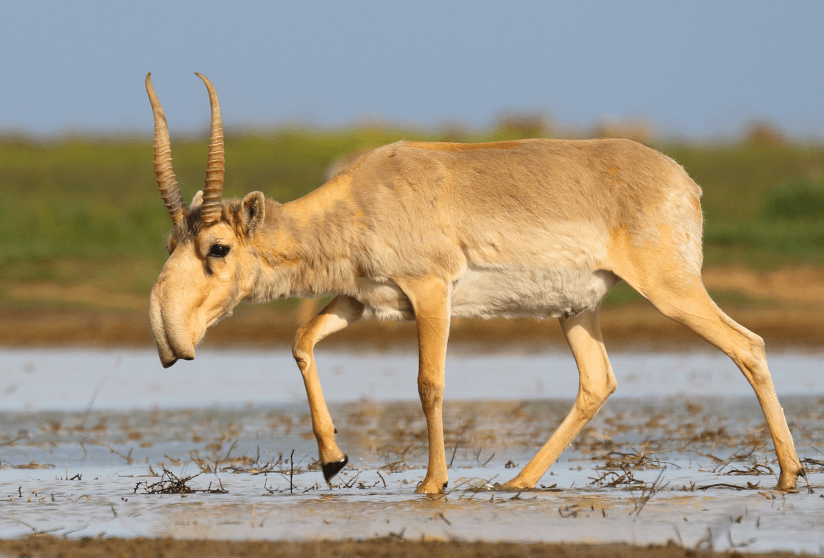
In 2015, a bacteria outbreak caused the deaths of more than 200,000 the critically endangered siaga antelopes in central Kazakhstan. The mass death happened too fast for infection to have been transmitted from one animal to another. Scientists believe pasteurella multocida, a bacteria that normally lives harmlessly in the animals’ tonsils, crossed into the bloodstream, causing the antelopes to die of hemorrhagic septicemia, or blood poisoning. Scientists think changed behavior of the bacteria in the host animals was triggered by relatively high humidity and temperature in the days before the MME, which wiped out more than 60 percent of the species’ world population.

Multiple Interacting Causes Spark Mass Death

A study of MMEs published in the Proceedings of the National Academy of Sciences in 2015 reports 727 MMEs involving 2,407 animal populations occurred since 1940, with the number of events and the number of animas killed increasing every year.

Adam Siepielski, an evolutionary ecologist at the University of Arkansas and a co-author of the paper, told The Guardian, “These reports of MMEs are probably underestimates in terms of occurrence and sheer magnitude. There is additionally a challenge in trying to understand whether this increased occurrence is a real event, or whether there are more people observing these things and [they are] more likely to report them.” The study found that factors directly related to climate, extremes of temperature, oxygen stress and starvation, contributed to a quarter of the events. Some 19 percent of the MMEs were related to human behavior such as pollution, and another quarter of the events was related to disease. Many have had multiple, entangled causes that interacted.

In Starfish and Antelope, Harmless Microbes Turned Deadly When Temperatures Rose

The massive death of hundreds of millions of starfish off the American west coast, from Alaska to Mexico, in 2013-2014 is one of the largest die-offs observed in the natural world. More than 20 species of starfish were sickened by a parvovirus that led to gastrointestinal problems. The virus left the creatures susceptible to bacterial infections, and within a week or two of the infection, the creatures died of a ghastly wasting disease that disintegrated their bodies.   A Seattle Times story by Lynda V. Mapes explains scientists have now concluded the deadly disease was triggered by warmer ocean temperatures. And like the bacteria that sparked the saiga antelope die-off, the virus that became problematic in starfish in warmer water, appears to have been harmlessly present in the starfish for decades or more.

Fragile Food Webs and Ecological Change

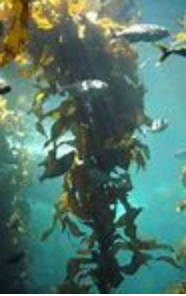
Screen Shot 2020-02-09 at 9.00.02 AMAn MME can push a species closer to extinction. But human health and fragile animal food webs are also at risk. Tidal pools on the west coast, for example, were once hosts to a healthy mix of species, including mussels and sea urchins. Starfish are voracious predators, that gobble mussels, sea urchins and other creatures. With starfish diminished, numbers of muscles and sea urchins are increasing, causing decline in availability of kelp. Kelp is a major source of food for sea urchins and many marine invertebrates. Scientific studies have shown loss of a species, from bacteria to mammals, can harm human health and that lost diversity is related to an increase in infectious disease.
Wikipedia images

Clouds of Fire Generate Dangerous New Weather Systems

The intense and boundless fires that have already devoured nearly 18 millions of acres of Australia are generating their own distinctive weather systems that spin off dangerous new storms and spread the inferno.

Gigantic blazes are sending columns of smoke as high as 30 miles above the earth, according to the Australian government Bureau of Meteorology, triggering electrical storms, as well as dry lightening and high winds that spread burning embers and start more fires. The dynamics inside the blazes themselves make the fires more unpredictable and harder to fight. Scientists say particles lifted into the stratosphere can travel thousands of miles and influence regional and global weather.

Tim Flannery, chief councillor for Australia’s Climate Council, writing in The New York Review of Books, says thousands of people who fled burning and endangered homes, many of them huddled on beaches, have been rescued by the military in what may turn out to be the nation’s biggest evacuation in history. Flannery reports that major roads have been blocked, the great cities of Melbourne and Sydney have been smoke bound for months, and air quality in the capital, Canberra, was so bad government and university offices were closed. He writes that blazes penetrated rainforest in Queensland and New South Wales, previously untouched by wild fires. Scientists estimate a million wild animals have died, and that some may face extinction. Australia’s fire season, which has usually been between December and March, has many weeks to go.

Unpredictable Winds

The Australian weather service explains how the complex interactions among fire, changeable weather, temperature and moisture let new weather systems develop within a blaze. Intense heat from the fire causes air to rise rapidly inside a plume of smoke. Turbulence of that hot air draws cooler outside air into the plume. As the air within the plume rises to higher elevations, atmospheric pressure drops, causing the plume to expand and cool further. If air cools enough, moisture in the air will condense, forming a cumulous cloud. As the cloud continues to expand and cool, condensation releases heat, making the cloud warmer and more buoyant. It can then accelerate into the lower stratosphere, where collisions of ice particles in the upper regions build up electrical charges that are discharged as lightening. The cloud, now having produced a thunderstorm, even without much rain, is now known as pyrocumulonimbus.

Screen Shot 2020-02-20 at 5.15.43 PM

Pyrocumulonimbus cloud seen from airplane at 10,000 feet-Wikipedia

These dangerous clouds generate strong unpredictable winds and unexpected fire behavior. The intense heat-induced updraft can suck in so much air so fast that furious winds from all directions blast toward the plume. Such winds can change direction quickly, and airborne burning embers have been known to ignite new fires miles away. Force of the winds has been known to snap tree trunks and pull trees out of the ground.

Firenados and Black Hail

An ABC story by Irena Ceranic quotes fire ecology specialist Kevin Tolhurst, an associate professor at Melbourne University, who describes “lightening created by the pyrocumulonimbus cloud that was created by the fire itself.” He said a fire tornado forms when the air is not only rising but starts to spin. While small fires can generate temporary air whirls, a firenado can be miles across and last longer. The world’s first firenado, according to the story, was observed in 2003 when Canberra bushfires destroyed 500 homes and took four lives. Inside a smoke plume, moisture in air that has risen high into atmosphere can condense and combine with soot and ash to form dark hail stones.

Scientists worry that pyrocumulonimbus clouds–that can even damage the ozone layer– are on the rise around the world, driven by warmer temperatures and more intense fires. Still, a Washington Post story by Andrew Freedman and Matthew Cappucci quotes Neil Lareau, a fire-cloud researcher at the University of Nevada, who says he has not seen pyrocumulonimbus clouds as large or as long-lasting as those now over Australia. When these clouds form, Lareau notes, “there comes a point at which the pyrocumulonimbus cloud is no longer subject to local weather influences, but rather becomes the predominant local weathermaker.”

Many local and global factors combined to produce the record-setting heat and drought that was making Australia a tinderbox in the summer and fall of 2019. Another Washington Post story by Freeman and Sarah Kaplan explains:

From the west, a seesaw circulation pattern known as the Indian Ocean Dipole caused air to sink over Australia, heating and drying the continent. Meanwhile, thousands of miles away and about 10 miles up, in the thin, frigid slice of the atmosphere on top of the South Pole, something shifted. In an event that is unprecedented in 40 years of record-keeping, temperatures over Antarctica rose rapidly, causing the polar vortex over the Southern Hemisphere to break down and even reverse direction. This had cascading effects on weather patterns: The westerly winds that blow across the Southern Ocean shifted northward. Cold fronts moved across Australia, bringing intense wind but little rain.

Scientists say the fire nightmare unfolding in Australia is an indication of the type of extreme events the rest of the world may soon face. Climate change and global warming may seem gradual, but sudden and dramatic local changes can occur unexpectedly in the world’s uncharted future.

Chaos Dynamics Aids Human Disease Immunity

Scientists and laymen have generally assumed that living organisms do best to avoid chaos in their regulatory systems. But researchers recently discovered that chaotic swings in the intensity of a certain protein within human cells can boost the immune system and provide resistance to several serious diseases.

Two researchers at the University of Copenhagen’s Niels Bohr Institute, Professor Mogens Hogh Jensen and Mathias Heltberg, a graduate student in biocomplexity, have discovered a new mechanism in the way bodily cells regulate themselves, according to a story in Neurosciencenews.com.

The researchers investigated a protein called NF-kB, which is produced within cells, and has a vital role in maintaining the body’s immune system. They discovered that chaotic swings in the concentration of NF-kB can activate genes that are not otherwise activated. They explain that when the concentration of the protein, which fluctuates over tie, is in a chaotic state, it activates different genes in ways that are most effective in boosting immunity. Chaotic dynamics is the branch of mathematics that focuses on the behavior of dynamical systems.

“The results can have a tremendous impact on our understanding of how the immune system functions and how the incidence of some of the most serious illnesses, including diabetes, cancer and Alzheimer’s, might be avoided., said Dr. Jensen, a professor of biocomplexity. “For example, we know that cancer is related to a failure of signaling within the body. So, to avoid cancer, it is imperative to have the right dynamic at work in cells.”

Heltberg suggested the discovery cold lead to new medications and treatments. “Therapies could also involve the withdrawal and testing of cells from a body to gauge whether cells are in the right condition to have the correct swings. If they aren’t, it may be possible to predict and discover illnesses before they occur,” he said.

The research is published in the January 8 online issue of Nature Communications.